Monday, February 15, 2016
the winter post: crafting time!
Last week my parents tipped me off to the existence of the Madrona Fiber Arts Winter Retreat, which sounded really neat and was almost in striking distance. I looked at the website and discovered there was a mini-class on stranded colorwork, which I have little to no experience with, and after contacting the organizers managed to get registered last minute. So yesterday morning I packed up some needles and the necessary yarn for the classwork—
which of course my faithful assistant had to inspect—
and off I went. (Please note the colors in those images are terrible; one is an olive brown and the other is a peacock teal.)
Wednesday, October 7, 2015
spider season
The rains have returned, and with them a lot of the hope that seemed lost in July and August. I went outside yesterday to sow a few seeds for winter-friendly crops, cabbages and greens, and discovered in peeking at neglected garden beds that they're not as disastrous as I feared. One of the raised beds has some sturdy parsnips growing in it; the other has potatoes and rejuvenated kale. The carrots that I left to go to seed over the summer did so, and scattered seed around their half of the bed, which is now already starting to produce tiny feathery seedlings. The everbearing strawberries take their name seriously and I brought in a heaping handful of them last night, and the raspberry canes that had all withered over the summer now have bright green, healthy leaves.
There's a lesson in this that I need to take to heart, and carry with me; Depression Brain is quick to declare that things are RUINED FOREVER but that's not what nature does. "Forever" is an awfully long time. Things change, and keep changing, and 'tis a rare wind that blows no-one any good. The rigid patterns that we declare "the right outcome" are never the only ones with value.
Spider season is a good time to meditate on that. They're some of the most maligned and ill-treated of our near neighbors, despite all they have to offer. Around here they become most visible in late August through sometime in October, plump orb weavers spinning broad webs between any plausible pair of attachment points (I've seen them suspended between power lines more than once). Things are changing, they say. We have things to accomplish before the long dark. I try to say hello and wish them good hunting when I see them. I try not to disturb their webs. They're readying to lay their eggs, wrapping up hundreds of them in a tiny silk pouch to safely wait out the winter and be ready to patrol next year's woods and fields. Many of them make a habit of tearing down and eating their damaged webs, reclaiming those proteins to be used again. They know that someone bumbling into their web doesn't mean things are ruined forever.
I should too.
Saturday, July 11, 2015
we'll just call it a fallow year
I ruined it shortly after taking the photo, though I'm sure I haven't deterred them for good. The host plant there is a red elderberry, and despite being the site of an extensive aphid farm it's thriving -- I planted it as a bare-root stick this spring and it's now tall enough to look me in the eyes, with rich green foliage and plenty of it. It's honestly the most successful of its group. The ants know how to pick a good farm site, I guess.
Mostly things are not happening this year. I spent some crucial months being not well enough to support the garden the way it needed, and now that we're having an alarmingly hot and extra-dry summer it's too late to recover any of the spring annual crops. I did get a few small onions out of the back garden, and the cherry tree I planted last year bore enough cherries this year for a batch of really delicious syrup to pour over ice cream (pit 2 cups tart cherries, place in small pot with 1/4 cup local honey, heat gently until boiling, simmer a few minutes, cool a little bit and serve). So it's not a complete loss? But a very good thing I'm not depending on my direct efforts for any substantial amount of food.
I'm going to have to attack the southeast corner of the garden with power tools, I think, where the neighbors haven't rooted out a blackberry problem and now it has spilled over the fence with a vengeance. And probably I should just sheet mulch 95% of the garden at this point and start over when the rains come back. Well. One learns even when one doesn't produce.
Monday, May 18, 2015
tree update
Just moved 4 of the 5 Indian plums i planted this spring from the native plant sale; the only one that was thriving was the one completely under the shade of the maple. The others were all sad little sticks with withered leaves. But they're not dead, so I moved them into shadier spots and watered them and hopefully they'll perk up a bit. Will have to remember to water them more often so they can get established.
I'm honestly not doing very well at getting a vegetable garden going this year, but I'm at least making some progress on the front. And I do have a few things to set out in the garden soon, including crookneck squash, paste tomatoes, and my tiny soviet melons.
The apple tree has loads of tiny fruit on it this year, after not setting any last year, so that's a good sign for pollination. The quince had lovely blossoms but is setting no fruit at all. The cherry is going to need bird netting any day now as its loads of green fruit start turning red. The peach has a terrible case of leaf curl and may not make it. The mulberry is young but beautiful.
Also I recently planted a madrona, because I love them dearly, and here's hoping it survives; they apparently are very hard to transplant and cope badly with any disturbance of the root system. But maybe!!!
Monday, March 16, 2015
tomato notes
Next repotting: april?
Friday, March 13, 2015
buried treasure!!!
Trowel included for scale. On the bright side, by the time I finally got it out of there, I had PLENTY of room for the bare roots of the plant.
The more sincere buried treasure that I've been turning up in all this digging is, of course, the worms. The dirt below the sod layer is pretty barren and compacted, but in among the grass roots I've been finding some nice fat earthworms. And they've already started to colonize the dirt I had trucked in, too, which I take it to mean that it meets with their approval. One of the ones I turned up the other day was so big I didn't recognize it at first glance. Onward, little detritovores!
This weekend I need to repot my tomatoes for the first time. They've gotten their first true leaves and are a bit leggy, so time to move them into 4-inch pots and bury some of that excess stem so it can get to rooting.
Saturday, March 7, 2015
Springing
I have two big outdoor goals this year: to no longer need to mow the front slope, and to encourage more pollinators to hang out here. I've been working on both of them in the last few weeks! Saturday of last week was the annual King Conservation District native plant sale. I preordered a few things, and then went down there with H so we could both buy some stuff in the walk-up sale too. Now, looking at the prices on the website, I thought "well, that's a little high but reasonable," and ordered two blue elderberries and one mock orange. Then we got to the sale, and we discovered that I had ordered two bundles etc, and that each bundle was 10 bare-root plants. We promptly strategically divided our lists so we didn't repeat species, and bought bundles of a bunch of other stuff too.
But then we have the best problem ever: so many plants that need to get in the ground! And it's a beautiful weekend! So for the rest of Saturday we worked in H's tiny back yard, where we moved around clumps of rosemary and oregano to make room for various exciting berries. She also gave me two of her rose bushes, since she's really short of space and I'm not so much, and when I got home I plopped those into the front garden bed beside the driveway, which has had a big blank spot in it ever since the old heating oil tank came out of its underground lair.
Sunday it was my turn.
Friday, January 9, 2015
buy less, make more
2015 got off to a bit of a rocky start for me -- I got food poisoning on the night of the 2nd. I'd never had the full-blown experience before, the fever and shakes and convulsive voiding of the whole GI tract by any available means. Now that I have, I think once was enough. I was mostly wiped out for the rest of the weekend and only started eating actual meals again on Monday. Food is still making me kind of nauseous most of the time, as my colonies of carefully selected internal symbiotes struggle to recover from the purge. I have been carefully applying small doses of kombucha and live-culture yogurt to encourage them. I miss my symbiotes. :(
This weekend, though! This weekend I'm going to sit down for real and make a plan for the garden. I think the rule is that I have to make a basic list before I open a catalog, so that I'm then shopping only for varieties instead of completely impulse buying. There are just too many beautiful things from Baker Creek otherwise.
Also this weekend, or later this month, making a plan for the front yard: the street-facing 1/3 or so of the yard is on a slope, which makes mowing it absolutely awful, so it's first on my list for replanting. I recently made a commitment to actively study and practice Druidry, and as part of that commitment I took a few vows to do things this year that would lessen my impact on the earth and improve the health of my environment. One of them was to rework that area from lawn (which supports very little wildlife) into a stand of native shrubs and wildflowers (which will support birds, bees, squirrels, butterflies, all the tiny unappreciated fauna that live in and around fertile soil....). I'm looking forward to the transformation so much. Even the part where it's going to take a lot of digging and grubbing in the dirt and digging some more.
Also also, I wanted to mention my one resolution for this year: buy less, make more. More and more, I find that consuming passively doesn't give me much pleasure, whereas the time and effort involved in making things to meet my own needs are immensely satisfying. Learn, make, thrive: the good life.
Tuesday, December 16, 2014
Planning season
The Baker Creek seed catalog reached me this week, which means I'm now swooning over pages and pages of full-color photos of beautiful, unusual vegetable varieties. Currently I'm mostly in the ridiculous wishlist phase (what if I tried amaranth again!) and only just starting to consider more practical considerations (early snap peas in the bed near the strawberries sure would be nice).
I'm thinking a lot, though, about how to manage seedlings' light needs. I want to be able to do tomatoes again, because they're such a staple in my kitchen. Given how late the warm season starts here, that means giving them a good long indoor stay to bulk up; last summer, the plants I got substantial production from were ones I bought from a nursery, and they started their seedlings in January or February.
They also almost definitely used grow lights to get theirs going, which I fussed about back in May. I'm still committed on principle to minimizing the external energy inputs I use for the garden, though, so I'm wondering about what I could do with our existing solar power. I've been thinking about trying to set up a reflective/mirrored screen to set behind the seedling trays, so it could bounce back sunlight from the window to give them a second shot at it. Ideally, that would give them extra light and heat to encourage growth without taking constant infusions of electricity. In a worst case, it just fries them. Maybe I'll set up a control group so I can actually measure what difference it makes.
Much later in the year, I think I'm going to want to start my fall seedlings outside this summer, instead of leaving them in the spare room (where honestly I think they probably baked). If I can get the cold frame done early this year, which just means getting off my lazy butt and doing the job, then I'll have a nice set-aside space; I can leave the glass top open and rig some kind of screen to filter the south and west sun, so they get some light but not enough to overwhelm them. Bonus, this minimizes the amount of hardening off they'll need when it's time to move them out to the beds.
Friday, December 12, 2014
la grisouille
And of course we're almost to the turning point already, the hinge where the dark stops getting darker and the sun is reborn. I'm going to make it. This winter, like all the winters before it, won't undo me. I'll see la grisouille melt, the first daffodils pushing their way up through the earth, the first buds turning to blossoms on trees. The wheel turns. We're headed that way soon.
Thursday, November 13, 2014
The Dark Season is well and truly upon us, which means there's little to no time for doing chores outside on weekdays; the sun's rising as I leave in the morning, and well down by the time I get off the bus home. But I found a warm red coat in the by-the-pound bins at Goodwill last weekend that probably cost me about $5, and now I am considerably more visible in people's headlights when I'm walking home in the dark.
We're currently having what passes for a cold snap in Seattle, the very edge of the freezing Jetstream produced when the remains of Nuri stormed into Alaska. Of course, "cold" around here means the lows are around freezing, which really shouldn't feel like a big deal after almost ten years in/around Philly and one terrible winter in Denver. That was practically a lifetime ago, though. Sometimes I wonder if anyone I knew back then would grok what I've become. The guy I moved to Denver with probably wouldn't. If anyone would, it's probably the Badgers; I hope they're doing well. Jimmi O'Badger, if you ever google yourself, we went to school together and you knew me as Lilith - drop me a line.
The me from back then was more brittle, I think, and also trying a lot harder to front about it. I was a surly little rivethead, who would have embraced news about this "internet of things" concept out of a sense of nihilism: if you can't fight the dystopia, you might as well take grim satisfaction in seeing it coming. Now I'm... well, maybe slightly less nihilistic. Still doing optimism wrong, because now I look at that and think, "It won't be able to last, between the people who refuse to be so intensely monitored and the increasing number of people who just can't afford all those toys. And they're depending on a lot of finite resources to build and sustain that stuff anyway." Which is more comforting than living in the consumer panopticon for the rest of my life, at least.
Plans for the rest of November: pick up the pace on making solstice presents for people; haul tomatoes and peaches out of the freezer and can some stuff now that it's cold out; mow the damn lawn one more time if it's ever dry on a weekend; jury duty; friendsgiving.
Monday, October 20, 2014
back on the post horse
I'm going to try to get back in the habit of posting here, on the theory that doing so will help me stay motivated to keep doing the actual things that get posted about. So here we are in the second half of October: I need to pull out my last tomato plants now that the wet is setting in, and bring in their unripe fruit to ripen in a paper bag. The fig tree is having its second crop after all, which I'd worried wouldn't ripen, so we need to harvest those also and figure out what to do with them. The south-end bed has purple barley and fava beans growing on one side, both of which are thriving, and garlic planted on the other, which is starting to sprout. I botched getting my early seedlings started for winter veggies, but a few of the kale might make it, and maybe I'll cave and buy a packet of starts from somewhere. Fortunately the chard from last winter appears not to have gotten the memo that it's an annual, and after I cut down the flowering stalks this summer the roots started sending up new leafy growth. So we can keep eating that for a while.
The corn-and-beans patch this summer was an absolute bust, and I suspect the culprit was just plain old low-quality dirt; that was a spot that had been lawn previously. Yesterday I dug the top shovelful under, with the plant matter intact, so it can rot under there over the winter (I did spot a couple of nice big earthworms, so at least I have a little help on this front). I'm going to add more actual finished compost and plant it over in a cover crop, probably field peas, for the winter.
I might do the same thing down front where the daylilies kind of got a hold but the pumpkins did nothing of substance; there, also, I'm dealing with recently ex-lawn. Generally I probably need to remember to be less impatient about getting things into the dirt in places that aren't ready -- spend an extra day on soil amendment and avoid wasting a whole season, self.
I did make a small order from Raintree before the winter set in, to get things into the ground and let them establish roots now, so they're ready to get going in the spring. I have a Camellia sinensis, better known as tea, and a King James mulberry, named after the fellow who planted the tree's progenitor in London a few hundred years ago (the original tree died in the Blitz, but enterprising horticulturalists managed to propagate enough shoots to keep its lineage going). #plantnerd
Another day, another chore. Tonight I need to clean out my kombucha operation and see if the poor mother is still in good enough shape to start a fresh batch. Also maybe see about taking samples for a soil test, if the ground isn't soaked (hah).
Friday, October 17, 2014
"when the zombies come"
Which is what makes "when the zombies come" such a powerful charm. Not to summon them, of course; not to bring on the apocalypse or anything of that nature. It's a ward against skeptics. It's an answer to questions that doesn't leave the speaker vulnerable. "Why would you bother to learn to [hunt/forage/smith/hand-spin]?" goes the question, with the implied "that's so time-consuming and obsolete." And a wry "When the zombies come, you'll be glad I can [find food/repair our tools/make new clothes]" soothes the skeptic, tells them It's okay, I'm like you, I believe in the same world you believe in, I'm just indulging in play. Sometimes of course the framing goes the other way and they're the ones asking for reassurance: "Can't hurt when the zombies come, huh?" as a reaction to someone learning a forgotten skill. Elaborating on the usefulness of the skill in the zombie scenario finishes the charm.
Because oftentimes answering that question seriously leads to a conversation that's exhausting and awkward. "When a pandemic scare breaks down social services" or "If the drought leads to food shortages" or "When fuel costs make it too expensive to ship cheap goods halfway across the world" are uncomfortable contingencies. They sit in that nasty place where people don't want to believe in them, but they are believable. The zombies are a "safe" disaster, the one we know won't arrive. Looking at the possibility of other disasters occurring (or worsening) and planning for them makes people uncomfortable. Why are you so pessimistic? Come on, they'll think of something! God, you're not some kind of prepper survivalist weirdo, are you?
I don't know. I'll cop to the pessimism easily. We are living, as they say, in interesting times. Climate change is an ongoing disaster all over the place. The global financial system is made up of a terrible baroque assemblage of mechanisms to make numbers get bigger, without a care for how they affect the standard of living of billions of people. The US has committed itself to repeated military engagements in the Middle East, spilling blood to ensure we retain access to oil. I don't have a lot of faith in The System to keep things running smoothly. Learning hands-on skills to take care of my immediate needs makes me feel a little better about my situation.
I have a three-hour class on spinning with a drop spindle tomorrow: one more step toward knowing how food and clothing happen without capital-I Industry. You know. In case the zombies come.
Tuesday, October 14, 2014
I promised you a knitting post
Because it's not just that knitting is a method of soothing the part of my brain that is comforted and calmed by doing simple repetitive tasks, though that's definitely part of it. It's not just the accomplishment of having those tasks result in a tangible reward. That's part of it too, obviously.
But it's also part of the same project as figuring out how to get tomatoes to grow in a Seattle season, and nailing together a compost bin from scrapped pallets with my own hands. It's about having useful skills, about connecting my time and labor more directly to the sources of my sustenance and comfort. (There's nothing like "working" in front of a computer for eight hours to make me go "...this feeds me how, exactly?") Being able to create a garment directly from twisted threads is good for me right down to the soul. (Being able to twist the threads in the first place would be even cooler; I'm signed up to take a class on using a drop spindle this coming Saturday.)
One of my current projects is a set of densely-knitted slipper socks from Andean Folk Knits: Great Designs from Peru, Chile, Argentina, Ecuador & Bolivia, by Marcia Lewandowski. Who is just as white as she sounds, and occasionally the book veers into using-your-culture-for-tourism territory, but mostly she's pretty aware of the tendency to do that and tries to avoid it -- pointing out, for example, that no matter how romantic she finds the idea of indigenous women hand-spinning, she can't argue with their desire to save time by using commercial yarn when she herself relies on her washing machine, dishwasher, and microwave to make necessary chores move faster. So that degree of self-awareness was nice to see.
Anyway, the thing I meant to say about the book: one of the things that's been neatest for me about it is the details about how working with fiber gets integrated with other things: herders working with drop spindles while they follow their animals. Men sharpening the ends of salvaged bicycle spokes to make sets of double-pointed needles. Colorwork designs being improvised to fit the garment as the knitter works. It's a very practical making approach (which doesn't mean it's dreary in the least; the colors and patterns built into these useful items are glorious).
In contrast it feels a bit like USian knitting culture has a strain of, well... consumerism to it. Acquire the best brand-name yarns! Use the most perfect exotic fibers! Stash a monstrous hoard of yarn you will never have time to use! Follow celebrity designers and rely on their technical expertise! Buy individual patterns! Use a vast array of needles in minutely varying sizes! It's a seductive approach that I am definitely not standing outside of -- I've spent more money than I should have on yarn in the last season. And there are some absolutely lovely finished objects that come out of this stuff-focused style. But I really want to try to remind myself that there is a full suite of skills here, not limited to following patterns; knowing how and why a piece is put together a certain way are crucial. Those are the parts that would let me improvise. That knowledge lets a craftsperson produce work that is more than the sum of its inputs.
And that's a goal I'm actually reaching for.
Tuesday, September 2, 2014
sweet victory!
That, my friends, is homebrew blackberry mead. (Also evidence that I need to write about knitting. But that's a different post.) I couldn't resist breaking into it this evening and trying it out, and I am pleased to report that it is quite drinkable. (This is my first brewing experience! That's a good bar to aim for.)
This was low-tech wild-fermented brew; I mixed three cups of honey with twelve cups of water in a bucket, then added a quart of foraged blackberries. I left it alone, stirring occasionally, for a few days, until the wild yeasts had gotten a chance to colonize it and start it frothing up. Then it went into a jug with an airlock to do its thing, and it has been there for... a month? six weeks?
It's still sweet at this point, just slightly fizzy, and the honey flavor comes to the fore first with the blackberries arriving as an aftertaste. I am so proud of myself.
Monday, August 18, 2014
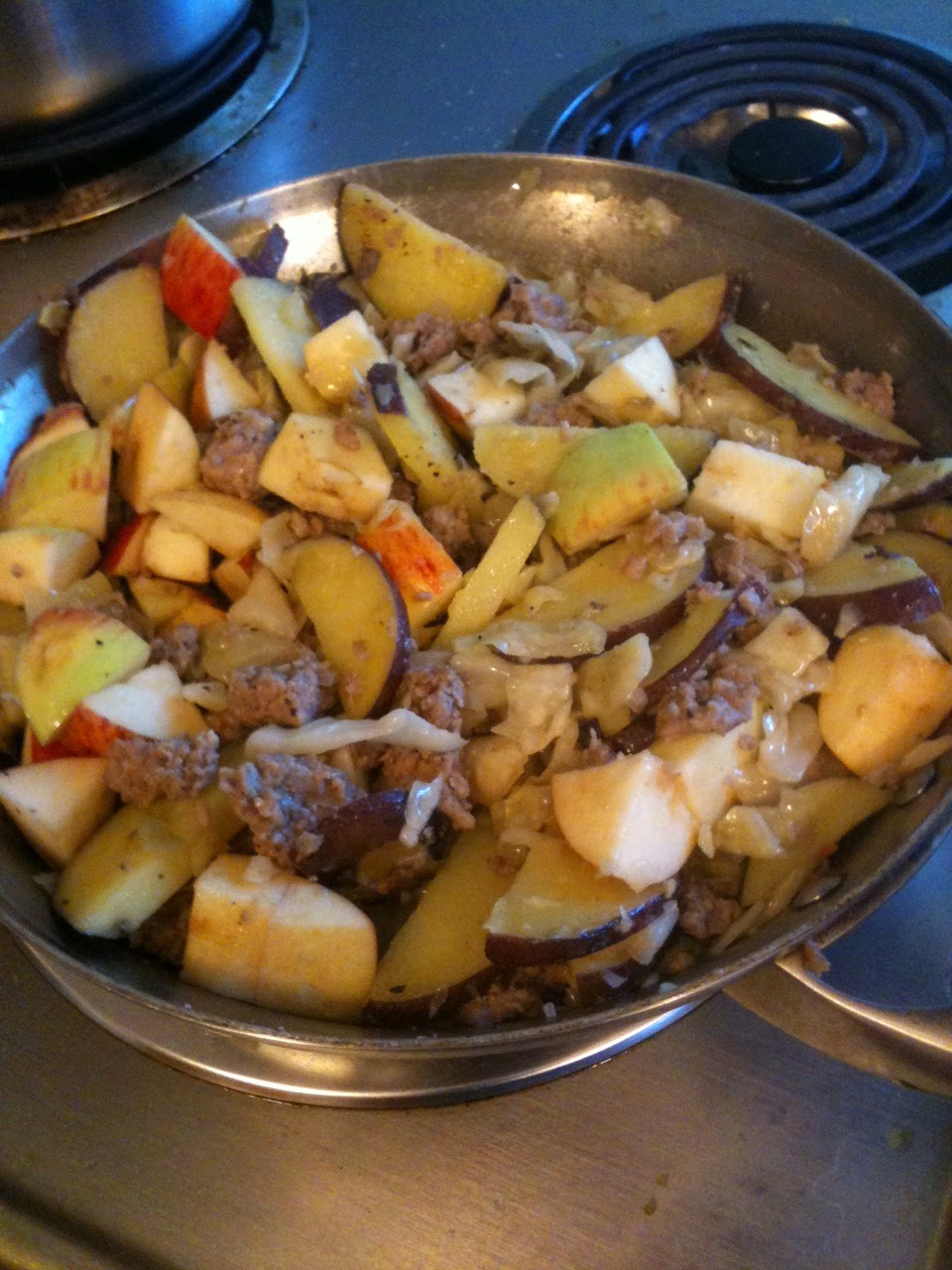
dinner!!!
Some nights it's spaghetti sauce out of a jar, but some nights the stars align for this. :3
Thursday, August 14, 2014
mid august???
It's harvest time now, a bit from the garden (I'm freezing a steady trickle of paste tomatoes in the hopes of having enough for a canning session by the end of the season) and a LOT from trees and bushes. My fig tree's fruit is ripening, and now we're inundated with fist-sized, brown-black fruit; I need to dig up recipes and figure out what I'm making with all of them. Harvest preservation! Whew. There's also been a lot of foraging: I went out with H to gather blackberries, and we got enough for her to start a five-gallon batch of wine and me to make four pints of jam. Then I went out again by myself the next week and snagged another quart of them to add to some wild-fermented mead, which is now almost ready to decant from secondary fermentation. Then last weekend we went over the hill to a nearby abandoned lot, which is apparently the remains of somebody's orchard; there are two apple trees still bearing -- enough for us to gather ten gallons of mostly-windfall fruit to press for cider -- and two tiny plum trees whose fruit is not quite ripe. Pretty sure I spotted a pear, also, but it bore no fruit, possibly due to being the last one left in the area.
In upcoming-harvest news, my tiger eye beans are producing big pods that are starting to turn brown on a few plants. Keeping an eye on those, because it would be super neat to harvest enough beans for some chili this winter. ...I'm probably *not* going to get a corn harvest, because I just planted too late; the plants are healthy but they're small, and at this point in the season they ought to be taller than I am and fluffy with silk. Lessons for next year!
Also I harvested my one little row of garbanzos, which ultimately wound up with about a handful of beans. They're not a productive enough crop for me to give them dedicated space next year, I don't think. BUT: the individual plants take up very little space, are self-supporting, and fix nitrogen. So the new plan is to just tuck them into corners between plantings of other things.
Wednesday, July 23, 2014
rain!
Next time I can get some photos uploaded I need to make happy noises about foraging blackberries, too.
Saturday, July 19, 2014
I honestly harvested these earlier than I would have in a perfect world; the heat this past week made the plants at the less-well-watered end of the row just keel right over. But there they are! I apparently forgot to note which variety these were, but they're lovely. Deep purple skins, creamy interiors. I planted a pound and I think I got five or six pounds back. Nowhere near enough for a winter's supply, clearly, but I'm treating this as my training wheels year. And tonight I'll make something with the ones whose skins got scraped in the digging. Maybe the purple green beans, too. Food season!
Sunday, July 13, 2014
kitchen adventures: sourdough!
I started this project about two weeks ago, when I collected a bag of hard red wheat flour from a local farmer (wheat they grew over on the Olympic peninsula, their own milling). I cultured the starter from scratch, following the instructions in Wild Fermentation to feed and coax and fuss over the flour soup until its yeasts developed enough to make it thick and bubbly. Yesterday I had a fluffy, rising jar of starter, so I figured it would be a good time to give the rest of the process a shot.
So in the morning I mixed one part starter, one part water, and two parts flour (more of the same bag) into a sort of porridge ("sponge"). The bowl got covered with a damp towel and ignored all day, 12 hours or so. Last night I took it down and added another two parts flour to make it a stiff bread dough, then kneaded it by hand until it had some spring.
At this point I diverged from instructions. It was bedtime, and we're having a heat wave, so very early and very late are the most comfortable times for baking. The book's instructions for the most basic sourdough loaf call for a double rise, first in a bowl/bucket to +50% bulk, then punched down and given a second rise in loaf pans. I just dumped the oiled dough into a loaf pan to leave it overnight.
And I think I can blame that for the ultimate texture -- well, that and the use of all whole-wheat flour, probably. But what I have is denser and flatter than commercial sourdough; it doesn't have the airy interior texture that I'm used to. When the weather is cooler sometime I'll try switching up the timing so I can do the double-rise and see how much that changes.
And the flavor? Pretty interesting! Less tang, less sharpness, than I expected, probably because I started it pretty much as soon as the starter seemed willing to play along. A sweet graininess in there somewhere from the whole wheat. The starter smelled, well, weird, and I wasn't really sure if I liked it, but that note has backed off a lot in the finished product.
It's not a perfect product by any means, but for a first attempt at a completely new process I'm pleased.