Note to self: first frost at the house this year was on November 10.
The Dark Season is well and truly upon us, which means there's little to no time for doing chores outside on weekdays; the sun's rising as I leave in the morning, and well down by the time I get off the bus home. But I found a warm red coat in the by-the-pound bins at Goodwill last weekend that probably cost me about $5, and now I am considerably more visible in people's headlights when I'm walking home in the dark.
We're currently having what passes for a cold snap in Seattle, the very edge of the freezing Jetstream produced when the remains of Nuri stormed into Alaska. Of course, "cold" around here means the lows are around freezing, which really shouldn't feel like a big deal after almost ten years in/around Philly and one terrible winter in Denver. That was practically a lifetime ago, though. Sometimes I wonder if anyone I knew back then would grok what I've become. The guy I moved to Denver with probably wouldn't. If anyone would, it's probably the Badgers; I hope they're doing well. Jimmi O'Badger, if you ever google yourself, we went to school together and you knew me as Lilith - drop me a line.
The me from back then was more brittle, I think, and also trying a lot harder to front about it. I was a surly little rivethead, who would have embraced news about this "internet of things" concept out of a sense of nihilism: if you can't fight the dystopia, you might as well take grim satisfaction in seeing it coming. Now I'm... well, maybe slightly less nihilistic. Still doing optimism wrong, because now I look at that and think, "It won't be able to last, between the people who refuse to be so intensely monitored and the increasing number of people who just can't afford all those toys. And they're depending on a lot of finite resources to build and sustain that stuff anyway." Which is more comforting than living in the consumer panopticon for the rest of my life, at least.
Plans for the rest of November: pick up the pace on making solstice presents for people; haul tomatoes and peaches out of the freezer and can some stuff now that it's cold out; mow the damn lawn one more time if it's ever dry on a weekend; jury duty; friendsgiving.
Thursday, November 13, 2014

Monday, October 20, 2014
back on the post horse
This morning on the way to work Skrillex's "Breakin' a Sweat" came on my phone and it was this moment of "yep, that's my life": taking transit to work, knitting, listening to a dubstep riff on Jim Morrison. I don't know. Something about the collision of disparate elements there.
I'm going to try to get back in the habit of posting here, on the theory that doing so will help me stay motivated to keep doing the actual things that get posted about. So here we are in the second half of October: I need to pull out my last tomato plants now that the wet is setting in, and bring in their unripe fruit to ripen in a paper bag. The fig tree is having its second crop after all, which I'd worried wouldn't ripen, so we need to harvest those also and figure out what to do with them. The south-end bed has purple barley and fava beans growing on one side, both of which are thriving, and garlic planted on the other, which is starting to sprout. I botched getting my early seedlings started for winter veggies, but a few of the kale might make it, and maybe I'll cave and buy a packet of starts from somewhere. Fortunately the chard from last winter appears not to have gotten the memo that it's an annual, and after I cut down the flowering stalks this summer the roots started sending up new leafy growth. So we can keep eating that for a while.
The corn-and-beans patch this summer was an absolute bust, and I suspect the culprit was just plain old low-quality dirt; that was a spot that had been lawn previously. Yesterday I dug the top shovelful under, with the plant matter intact, so it can rot under there over the winter (I did spot a couple of nice big earthworms, so at least I have a little help on this front). I'm going to add more actual finished compost and plant it over in a cover crop, probably field peas, for the winter.
I might do the same thing down front where the daylilies kind of got a hold but the pumpkins did nothing of substance; there, also, I'm dealing with recently ex-lawn. Generally I probably need to remember to be less impatient about getting things into the dirt in places that aren't ready -- spend an extra day on soil amendment and avoid wasting a whole season, self.
I did make a small order from Raintree before the winter set in, to get things into the ground and let them establish roots now, so they're ready to get going in the spring. I have a Camellia sinensis, better known as tea, and a King James mulberry, named after the fellow who planted the tree's progenitor in London a few hundred years ago (the original tree died in the Blitz, but enterprising horticulturalists managed to propagate enough shoots to keep its lineage going). #plantnerd
Another day, another chore. Tonight I need to clean out my kombucha operation and see if the poor mother is still in good enough shape to start a fresh batch. Also maybe see about taking samples for a soil test, if the ground isn't soaked (hah).
I'm going to try to get back in the habit of posting here, on the theory that doing so will help me stay motivated to keep doing the actual things that get posted about. So here we are in the second half of October: I need to pull out my last tomato plants now that the wet is setting in, and bring in their unripe fruit to ripen in a paper bag. The fig tree is having its second crop after all, which I'd worried wouldn't ripen, so we need to harvest those also and figure out what to do with them. The south-end bed has purple barley and fava beans growing on one side, both of which are thriving, and garlic planted on the other, which is starting to sprout. I botched getting my early seedlings started for winter veggies, but a few of the kale might make it, and maybe I'll cave and buy a packet of starts from somewhere. Fortunately the chard from last winter appears not to have gotten the memo that it's an annual, and after I cut down the flowering stalks this summer the roots started sending up new leafy growth. So we can keep eating that for a while.
The corn-and-beans patch this summer was an absolute bust, and I suspect the culprit was just plain old low-quality dirt; that was a spot that had been lawn previously. Yesterday I dug the top shovelful under, with the plant matter intact, so it can rot under there over the winter (I did spot a couple of nice big earthworms, so at least I have a little help on this front). I'm going to add more actual finished compost and plant it over in a cover crop, probably field peas, for the winter.
I might do the same thing down front where the daylilies kind of got a hold but the pumpkins did nothing of substance; there, also, I'm dealing with recently ex-lawn. Generally I probably need to remember to be less impatient about getting things into the dirt in places that aren't ready -- spend an extra day on soil amendment and avoid wasting a whole season, self.
I did make a small order from Raintree before the winter set in, to get things into the ground and let them establish roots now, so they're ready to get going in the spring. I have a Camellia sinensis, better known as tea, and a King James mulberry, named after the fellow who planted the tree's progenitor in London a few hundred years ago (the original tree died in the Blitz, but enterprising horticulturalists managed to propagate enough shoots to keep its lineage going). #plantnerd
Another day, another chore. Tonight I need to clean out my kombucha operation and see if the poor mother is still in good enough shape to start a fresh batch. Also maybe see about taking samples for a soil test, if the ground isn't soaked (hah).
Friday, October 17, 2014
"when the zombies come"
I'm pretty sure zombies have infiltrated pop culture more thoroughly than any other monster figure. They've gotten their teeth into literature. They organize flash mobs. They get runners motivated. The military plans for them. They have a lot of mojo right now.
Which is what makes "when the zombies come" such a powerful charm. Not to summon them, of course; not to bring on the apocalypse or anything of that nature. It's a ward against skeptics. It's an answer to questions that doesn't leave the speaker vulnerable. "Why would you bother to learn to [hunt/forage/smith/hand-spin]?" goes the question, with the implied "that's so time-consuming and obsolete." And a wry "When the zombies come, you'll be glad I can [find food/repair our tools/make new clothes]" soothes the skeptic, tells them It's okay, I'm like you, I believe in the same world you believe in, I'm just indulging in play. Sometimes of course the framing goes the other way and they're the ones asking for reassurance: "Can't hurt when the zombies come, huh?" as a reaction to someone learning a forgotten skill. Elaborating on the usefulness of the skill in the zombie scenario finishes the charm.
Because oftentimes answering that question seriously leads to a conversation that's exhausting and awkward. "When a pandemic scare breaks down social services" or "If the drought leads to food shortages" or "When fuel costs make it too expensive to ship cheap goods halfway across the world" are uncomfortable contingencies. They sit in that nasty place where people don't want to believe in them, but they are believable. The zombies are a "safe" disaster, the one we know won't arrive. Looking at the possibility of other disasters occurring (or worsening) and planning for them makes people uncomfortable. Why are you so pessimistic? Come on, they'll think of something! God, you're not some kind of prepper survivalist weirdo, are you?
I don't know. I'll cop to the pessimism easily. We are living, as they say, in interesting times. Climate change is an ongoing disaster all over the place. The global financial system is made up of a terrible baroque assemblage of mechanisms to make numbers get bigger, without a care for how they affect the standard of living of billions of people. The US has committed itself to repeated military engagements in the Middle East, spilling blood to ensure we retain access to oil. I don't have a lot of faith in The System to keep things running smoothly. Learning hands-on skills to take care of my immediate needs makes me feel a little better about my situation.
I have a three-hour class on spinning with a drop spindle tomorrow: one more step toward knowing how food and clothing happen without capital-I Industry. You know. In case the zombies come.
Which is what makes "when the zombies come" such a powerful charm. Not to summon them, of course; not to bring on the apocalypse or anything of that nature. It's a ward against skeptics. It's an answer to questions that doesn't leave the speaker vulnerable. "Why would you bother to learn to [hunt/forage/smith/hand-spin]?" goes the question, with the implied "that's so time-consuming and obsolete." And a wry "When the zombies come, you'll be glad I can [find food/repair our tools/make new clothes]" soothes the skeptic, tells them It's okay, I'm like you, I believe in the same world you believe in, I'm just indulging in play. Sometimes of course the framing goes the other way and they're the ones asking for reassurance: "Can't hurt when the zombies come, huh?" as a reaction to someone learning a forgotten skill. Elaborating on the usefulness of the skill in the zombie scenario finishes the charm.
Because oftentimes answering that question seriously leads to a conversation that's exhausting and awkward. "When a pandemic scare breaks down social services" or "If the drought leads to food shortages" or "When fuel costs make it too expensive to ship cheap goods halfway across the world" are uncomfortable contingencies. They sit in that nasty place where people don't want to believe in them, but they are believable. The zombies are a "safe" disaster, the one we know won't arrive. Looking at the possibility of other disasters occurring (or worsening) and planning for them makes people uncomfortable. Why are you so pessimistic? Come on, they'll think of something! God, you're not some kind of prepper survivalist weirdo, are you?
I don't know. I'll cop to the pessimism easily. We are living, as they say, in interesting times. Climate change is an ongoing disaster all over the place. The global financial system is made up of a terrible baroque assemblage of mechanisms to make numbers get bigger, without a care for how they affect the standard of living of billions of people. The US has committed itself to repeated military engagements in the Middle East, spilling blood to ensure we retain access to oil. I don't have a lot of faith in The System to keep things running smoothly. Learning hands-on skills to take care of my immediate needs makes me feel a little better about my situation.
I have a three-hour class on spinning with a drop spindle tomorrow: one more step toward knowing how food and clothing happen without capital-I Industry. You know. In case the zombies come.
Tuesday, October 14, 2014
I promised you a knitting post
A million years ago. Whoops! I actually wound up making a version of it over on the author blog, but I think I still need to make a slightly different one over here.
Because it's not just that knitting is a method of soothing the part of my brain that is comforted and calmed by doing simple repetitive tasks, though that's definitely part of it. It's not just the accomplishment of having those tasks result in a tangible reward. That's part of it too, obviously.
But it's also part of the same project as figuring out how to get tomatoes to grow in a Seattle season, and nailing together a compost bin from scrapped pallets with my own hands. It's about having useful skills, about connecting my time and labor more directly to the sources of my sustenance and comfort. (There's nothing like "working" in front of a computer for eight hours to make me go "...this feeds me how, exactly?") Being able to create a garment directly from twisted threads is good for me right down to the soul. (Being able to twist the threads in the first place would be even cooler; I'm signed up to take a class on using a drop spindle this coming Saturday.)
One of my current projects is a set of densely-knitted slipper socks from Andean Folk Knits: Great Designs from Peru, Chile, Argentina, Ecuador & Bolivia, by Marcia Lewandowski. Who is just as white as she sounds, and occasionally the book veers into using-your-culture-for-tourism territory, but mostly she's pretty aware of the tendency to do that and tries to avoid it -- pointing out, for example, that no matter how romantic she finds the idea of indigenous women hand-spinning, she can't argue with their desire to save time by using commercial yarn when she herself relies on her washing machine, dishwasher, and microwave to make necessary chores move faster. So that degree of self-awareness was nice to see.
Anyway, the thing I meant to say about the book: one of the things that's been neatest for me about it is the details about how working with fiber gets integrated with other things: herders working with drop spindles while they follow their animals. Men sharpening the ends of salvaged bicycle spokes to make sets of double-pointed needles. Colorwork designs being improvised to fit the garment as the knitter works. It's a very practical making approach (which doesn't mean it's dreary in the least; the colors and patterns built into these useful items are glorious).
In contrast it feels a bit like USian knitting culture has a strain of, well... consumerism to it. Acquire the best brand-name yarns! Use the most perfect exotic fibers! Stash a monstrous hoard of yarn you will never have time to use! Follow celebrity designers and rely on their technical expertise! Buy individual patterns! Use a vast array of needles in minutely varying sizes! It's a seductive approach that I am definitely not standing outside of -- I've spent more money than I should have on yarn in the last season. And there are some absolutely lovely finished objects that come out of this stuff-focused style. But I really want to try to remind myself that there is a full suite of skills here, not limited to following patterns; knowing how and why a piece is put together a certain way are crucial. Those are the parts that would let me improvise. That knowledge lets a craftsperson produce work that is more than the sum of its inputs.
And that's a goal I'm actually reaching for.
Because it's not just that knitting is a method of soothing the part of my brain that is comforted and calmed by doing simple repetitive tasks, though that's definitely part of it. It's not just the accomplishment of having those tasks result in a tangible reward. That's part of it too, obviously.
But it's also part of the same project as figuring out how to get tomatoes to grow in a Seattle season, and nailing together a compost bin from scrapped pallets with my own hands. It's about having useful skills, about connecting my time and labor more directly to the sources of my sustenance and comfort. (There's nothing like "working" in front of a computer for eight hours to make me go "...this feeds me how, exactly?") Being able to create a garment directly from twisted threads is good for me right down to the soul. (Being able to twist the threads in the first place would be even cooler; I'm signed up to take a class on using a drop spindle this coming Saturday.)
One of my current projects is a set of densely-knitted slipper socks from Andean Folk Knits: Great Designs from Peru, Chile, Argentina, Ecuador & Bolivia, by Marcia Lewandowski. Who is just as white as she sounds, and occasionally the book veers into using-your-culture-for-tourism territory, but mostly she's pretty aware of the tendency to do that and tries to avoid it -- pointing out, for example, that no matter how romantic she finds the idea of indigenous women hand-spinning, she can't argue with their desire to save time by using commercial yarn when she herself relies on her washing machine, dishwasher, and microwave to make necessary chores move faster. So that degree of self-awareness was nice to see.
Anyway, the thing I meant to say about the book: one of the things that's been neatest for me about it is the details about how working with fiber gets integrated with other things: herders working with drop spindles while they follow their animals. Men sharpening the ends of salvaged bicycle spokes to make sets of double-pointed needles. Colorwork designs being improvised to fit the garment as the knitter works. It's a very practical making approach (which doesn't mean it's dreary in the least; the colors and patterns built into these useful items are glorious).
In contrast it feels a bit like USian knitting culture has a strain of, well... consumerism to it. Acquire the best brand-name yarns! Use the most perfect exotic fibers! Stash a monstrous hoard of yarn you will never have time to use! Follow celebrity designers and rely on their technical expertise! Buy individual patterns! Use a vast array of needles in minutely varying sizes! It's a seductive approach that I am definitely not standing outside of -- I've spent more money than I should have on yarn in the last season. And there are some absolutely lovely finished objects that come out of this stuff-focused style. But I really want to try to remind myself that there is a full suite of skills here, not limited to following patterns; knowing how and why a piece is put together a certain way are crucial. Those are the parts that would let me improvise. That knowledge lets a craftsperson produce work that is more than the sum of its inputs.
And that's a goal I'm actually reaching for.
Tuesday, September 2, 2014
sweet victory!
.JPG)
That, my friends, is homebrew blackberry mead. (Also evidence that I need to write about knitting. But that's a different post.) I couldn't resist breaking into it this evening and trying it out, and I am pleased to report that it is quite drinkable. (This is my first brewing experience! That's a good bar to aim for.)
This was low-tech wild-fermented brew; I mixed three cups of honey with twelve cups of water in a bucket, then added a quart of foraged blackberries. I left it alone, stirring occasionally, for a few days, until the wild yeasts had gotten a chance to colonize it and start it frothing up. Then it went into a jug with an airlock to do its thing, and it has been there for... a month? six weeks?
It's still sweet at this point, just slightly fizzy, and the honey flavor comes to the fore first with the blackberries arriving as an aftertaste. I am so proud of myself.
Monday, August 18, 2014
dinner!!!
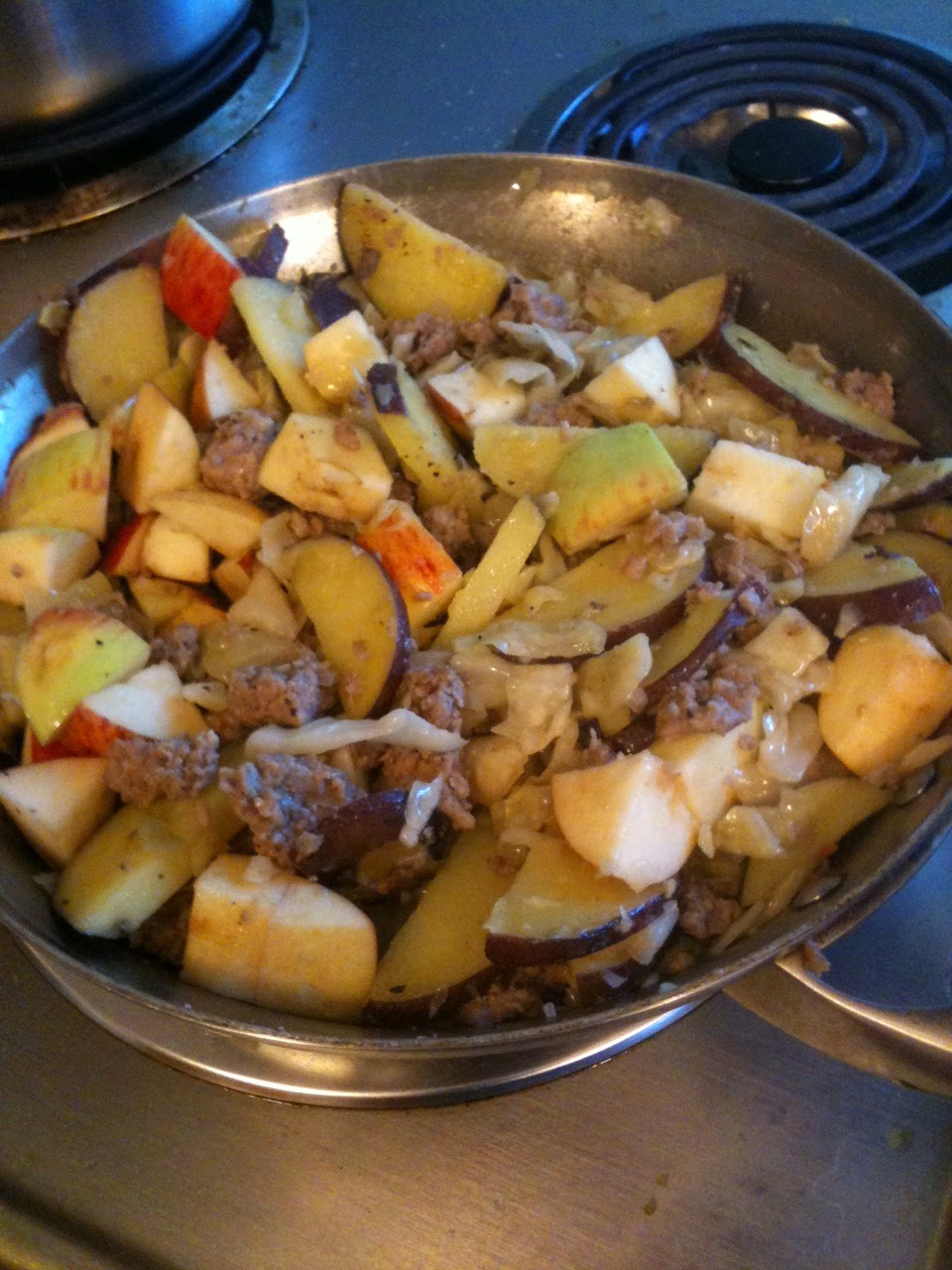
Some nights it's spaghetti sauce out of a jar, but some nights the stars align for this. :3
Thursday, August 14, 2014
mid august???
I keep not posting because I mean to take pictures, or I mean to upload pictures, or I forget when I sit down at the computer, or...
It's harvest time now, a bit from the garden (I'm freezing a steady trickle of paste tomatoes in the hopes of having enough for a canning session by the end of the season) and a LOT from trees and bushes. My fig tree's fruit is ripening, and now we're inundated with fist-sized, brown-black fruit; I need to dig up recipes and figure out what I'm making with all of them. Harvest preservation! Whew. There's also been a lot of foraging: I went out with H to gather blackberries, and we got enough for her to start a five-gallon batch of wine and me to make four pints of jam. Then I went out again by myself the next week and snagged another quart of them to add to some wild-fermented mead, which is now almost ready to decant from secondary fermentation. Then last weekend we went over the hill to a nearby abandoned lot, which is apparently the remains of somebody's orchard; there are two apple trees still bearing -- enough for us to gather ten gallons of mostly-windfall fruit to press for cider -- and two tiny plum trees whose fruit is not quite ripe. Pretty sure I spotted a pear, also, but it bore no fruit, possibly due to being the last one left in the area.
In upcoming-harvest news, my tiger eye beans are producing big pods that are starting to turn brown on a few plants. Keeping an eye on those, because it would be super neat to harvest enough beans for some chili this winter. ...I'm probably *not* going to get a corn harvest, because I just planted too late; the plants are healthy but they're small, and at this point in the season they ought to be taller than I am and fluffy with silk. Lessons for next year!
Also I harvested my one little row of garbanzos, which ultimately wound up with about a handful of beans. They're not a productive enough crop for me to give them dedicated space next year, I don't think. BUT: the individual plants take up very little space, are self-supporting, and fix nitrogen. So the new plan is to just tuck them into corners between plantings of other things.
It's harvest time now, a bit from the garden (I'm freezing a steady trickle of paste tomatoes in the hopes of having enough for a canning session by the end of the season) and a LOT from trees and bushes. My fig tree's fruit is ripening, and now we're inundated with fist-sized, brown-black fruit; I need to dig up recipes and figure out what I'm making with all of them. Harvest preservation! Whew. There's also been a lot of foraging: I went out with H to gather blackberries, and we got enough for her to start a five-gallon batch of wine and me to make four pints of jam. Then I went out again by myself the next week and snagged another quart of them to add to some wild-fermented mead, which is now almost ready to decant from secondary fermentation. Then last weekend we went over the hill to a nearby abandoned lot, which is apparently the remains of somebody's orchard; there are two apple trees still bearing -- enough for us to gather ten gallons of mostly-windfall fruit to press for cider -- and two tiny plum trees whose fruit is not quite ripe. Pretty sure I spotted a pear, also, but it bore no fruit, possibly due to being the last one left in the area.
In upcoming-harvest news, my tiger eye beans are producing big pods that are starting to turn brown on a few plants. Keeping an eye on those, because it would be super neat to harvest enough beans for some chili this winter. ...I'm probably *not* going to get a corn harvest, because I just planted too late; the plants are healthy but they're small, and at this point in the season they ought to be taller than I am and fluffy with silk. Lessons for next year!
Also I harvested my one little row of garbanzos, which ultimately wound up with about a handful of beans. They're not a productive enough crop for me to give them dedicated space next year, I don't think. BUT: the individual plants take up very little space, are self-supporting, and fix nitrogen. So the new plan is to just tuck them into corners between plantings of other things.
Subscribe to:
Posts (Atom)